Dental Implants in Bellmore, NY
Bedford Dental • 219 S Bedford Ave, Bellmore, NY 11710 • (516) 636-5554
When you lose a tooth, what fills the gap matters far more than most people realize. A missing tooth is not just a cosmetic problem — the bone underneath begins to shrink within months, neighboring teeth start to drift, and your bite quietly redistributes load to teeth that were never meant to carry it. Dental implants are the only tooth-replacement option that addresses all three problems at once. At Bedford Dental, Dr. Isabel Yuabov places single-tooth implants for patients across Bellmore and the South Shore of Long Island using 3D CBCT planning, modern titanium and zirconia systems, and a calm, sedation-friendly approach designed for nervous patients.
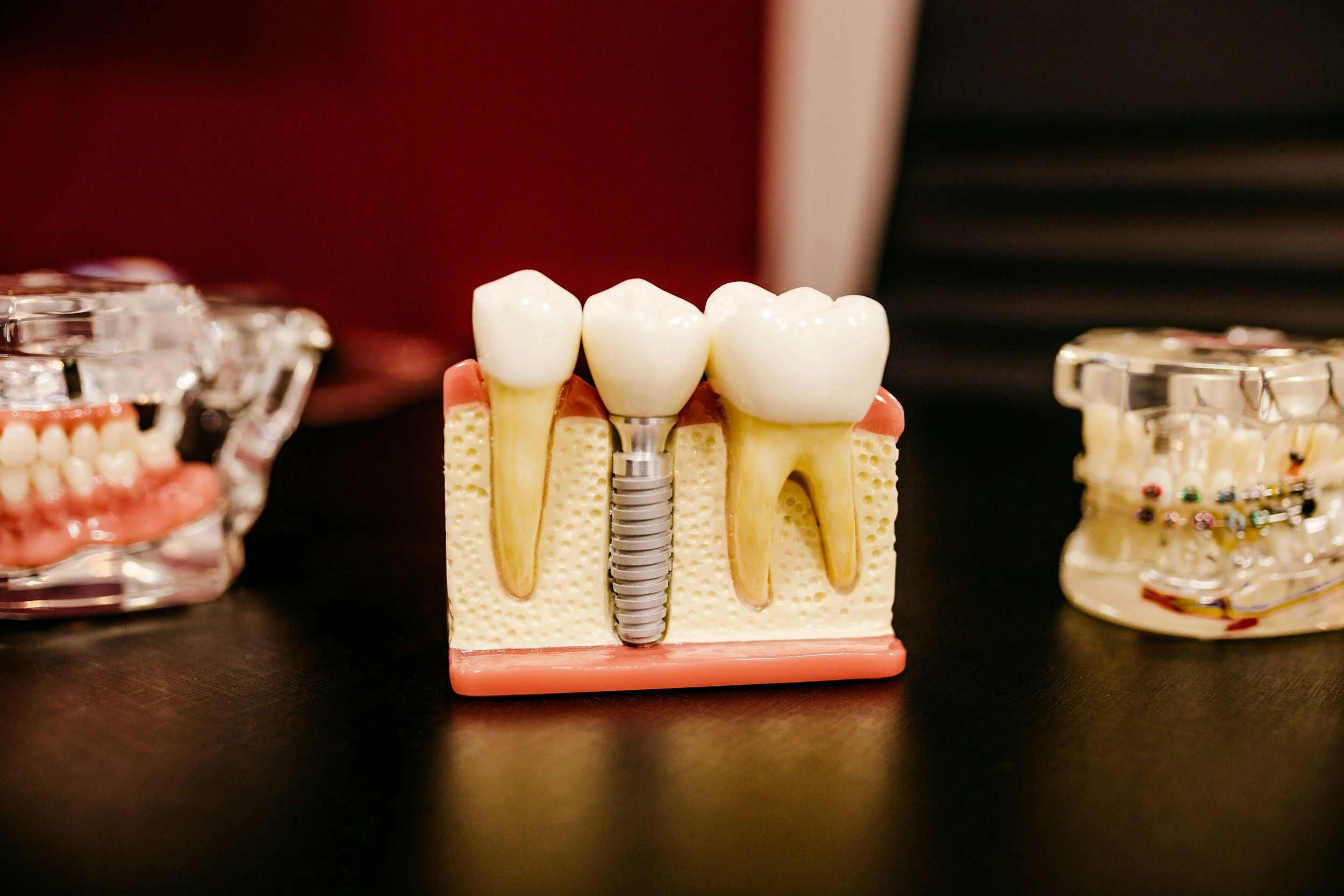
A dental implant is a small medical-grade titanium (or, in select cases, zirconia) post that is placed into the jawbone where the root of your missing tooth used to be. Over the next few months, the bone literally fuses to the surface of the post — a biological process called osseointegration that has been refined and studied in dentistry since the 1960s. Once the implant is fully integrated, Dr. Yuabov attaches a small connector called an abutment and tops it with a custom-shaded porcelain or zirconia crown. The finished restoration looks, feels, and chews like a natural tooth — and unlike a dental bridge, it does not require us to grind down the healthy teeth on either side.
Why Dental Implants Are the Gold Standard for a Missing Tooth
Implants are widely considered the gold standard in modern restorative dentistry for three reasons: they preserve the jawbone, they leave the neighboring teeth untouched, and with proper care they can last for the rest of your life. Studies of single-tooth implants consistently report success rates of 95% to 98% at ten years — numbers that compare favorably to virtually any other long-term restoration in dentistry.
Preserves your jawbone. The implant signals the bone the same way a natural tooth root does, preventing the shrinkage and "sunken" facial appearance that follows tooth loss.
Protects neighboring teeth. Unlike a bridge, an implant stands alone. Healthy teeth on either side are left exactly as they are.
Looks and feels like your own tooth. The crown is shade-matched to your surrounding teeth and emerges naturally from the gum line.
Restores full chewing power. Patients consistently report that an implant feels indistinguishable from a natural tooth within a few weeks.
Built to last. With routine professional cleanings and good home care, the post itself often lasts a lifetime.
The Single-Tooth Implant Process at Bedford Dental
Most single-tooth implant cases follow the same five-step arc, and Dr. Yuabov walks you through every milestone in advance so there are no surprises.
1. Consultation and 3D imaging. Your first visit includes a full clinical exam, digital X-rays, and — when needed — a cone beam CT (CBCT) scan that shows your jawbone in three dimensions. This lets us measure bone height, density, and the exact location of nerves and sinus floors before we plan a single move.
2. Extraction and (sometimes) socket preservation. If the failing tooth is still in place, we coordinate the extraction and, in many cases, place a small bone graft into the empty socket the same day. This "socket preservation" graft holds the bone volume so the future implant has a stable foundation. Healing typically takes 3–4 months.
3. Surgical placement. When the site is ready, the titanium post is placed under local anesthesia. Most patients describe the appointment as easier than they expected — pressure rather than pain. We offer nitrous oxide ("laughing gas") and oral conscious sedation for patients who want to be more relaxed during the procedure.
4. Osseointegration. The implant is left to heal beneath the gum for roughly 3–4 months in the lower jaw and 4–6 months in the upper jaw. Bone cells grow directly onto the implant surface during this period. Most patients wear a temporary tooth-replacement appliance and notice no functional limitation in everyday life.
5. Abutment and custom crown. Once the implant is fully integrated, we attach the abutment and seat your final, custom-fabricated crown. The crown is shade-matched to your other teeth, contoured to the gum line, and adjusted to your bite so it feels exactly like the tooth it replaces.
If you are missing significant bone height — common after a tooth has been gone for several years, or after gum disease — Dr. Yuabov may recommend a bone graft before placement, or a sinus lift for upper-back implants where the sinus floor sits too low. Both procedures are routine and predictable, and we plan them as part of the overall treatment timeline.
Am I a Candidate for a Dental Implant?
Most healthy adults missing a single tooth are excellent candidates. The two requirements that matter most are healthy gum tissue and enough jawbone to support the implant — and when bone is short, we can usually rebuild it. Patients who are best served by a different approach (or who need optimization first) tend to fall into a few categories: uncontrolled diabetes or autoimmune conditions, current heavy smoking, recent IV bisphosphonate therapy, or untreated periodontal disease. None of these is necessarily a permanent disqualifier — many simply need to be addressed first. For patients missing multiple adjacent teeth or an entire arch, Dr. Yuabov also offers full-arch All-on-X implants, which restore an entire row of teeth on as few as four implants.
Cost, Insurance, and Financing in Bellmore
A single dental implant in the Bellmore area typically runs $3,000 to $5,000 all-in — that is, the implant post, the abutment, and the final crown together. Bone grafting, sinus lifts, sedation, and CBCT imaging are itemized separately when needed, and we always provide a written estimate before any work begins. Most dental insurance plans now offer at least partial coverage for implant restorations, and many medical plans cover related procedures (such as extractions or grafts performed for a medical reason). Our front-desk team verifies your benefits in writing before treatment, and we work with CareCredit for patients who prefer to spread the investment over 6, 12, or 24 months at low or zero interest.
Why Bedford Dental for Your Implant
Dr. Isabel Yuabov leads a small, patient-focused practice five minutes from the Bellmore LIRR station, serving Bellmore, North Bellmore, Merrick, Wantagh, Seaford, Levittown, Massapequa, and Freeport. We perform consultation, 3D planning, extraction, grafting, and the final crown all in-house, and we coordinate the surgical placement step with care so every patient knows exactly who is doing what. If you are exploring a single-tooth implant — or considering cosmetic options for several teeth at once — call (516) 636-5554 or request a consultation online to start the conversation.
Frequently Asked Questions About Dental Implants
How much does a dental implant cost in Bellmore, NY?
A single dental implant at Bedford Dental typically ranges from $3,000 to $5,000 all-in, including the titanium post, the abutment, and the final custom crown. Cases that require additional procedures — such as a bone graft, a sinus lift, an extraction, CBCT imaging, or sedation — are quoted separately so you can see the full picture before you commit. We offer transparent, itemized estimates at your consultation, verify your insurance benefits in writing, and accept CareCredit for flexible monthly payments. Call (516) 636-5554 for a no-obligation quote.
Is a dental implant worth it?
For most patients, yes — particularly when the alternatives are weighed honestly. A dental bridge costs less upfront but requires grinding down two healthy teeth and does nothing to stop the bone shrinkage that follows tooth loss. A removable partial denture can shift while you eat or speak. An implant is the only option that replaces the root, preserves the jawbone, and stands completely independent of your other teeth. With success rates of 95–98% over ten years and a typical lifespan that often matches the patient’s, an implant is usually the most cost-effective restoration when measured per year of service.
How long do dental implants last?
The implant post itself — the titanium screw inside the bone — frequently lasts the rest of the patient’s life. The crown that sits on top is the part that wears: most porcelain or zirconia crowns last 10 to 20 years before they need to be refreshed, and replacing the crown does not require touching the implant beneath it. Daily brushing and flossing, twice-yearly professional cleanings, and a night guard if you grind your teeth are the three habits that move an implant from "lasts a long time" to "lasts a lifetime."
Does the dental implant procedure hurt?
The surgery itself is performed under local anesthesia, so there is no sharp pain during placement — most patients describe the sensation as pressure rather than discomfort. The vast majority of single-tooth implants are placed in 60 to 90 minutes. Post-op soreness is typically mild and well-managed with over-the-counter ibuprofen for two or three days; many patients take nothing at all by day three. For patients with dental anxiety, Bedford Dental offers nitrous oxide and oral conscious sedation so you can be fully relaxed throughout. Call (516) 636-5554 to ask about sedation options at your consultation.
How long is recovery after implant surgery?
Most patients are back to work and normal daily activity within 24 to 48 hours. Mild swelling and bruising peak around day two and resolve over the following week. Soft foods are recommended for the first few days, and the gum heals over the implant in about two weeks. The longer phase — osseointegration, when the bone bonds to the implant surface — runs roughly three to four months in the lower jaw and four to six months in the upper jaw. You wear a temporary during this period and feel nothing different in everyday life.
Implant vs. bridge — which is better for one missing tooth?
For a single missing tooth between two healthy neighbors, a dental implant is almost always the better long-term choice. A dental bridge requires grinding down the two adjacent teeth to anchor the bridge, and it does nothing to stop the bone underneath the missing tooth from shrinking. An implant stands on its own, preserves the jawbone, and leaves your healthy neighbors untouched. Bridges still have a place — patients with limited bone, cost constraints, or specific medical situations sometimes choose them — but for a healthy adult, an implant typically delivers more years of service per dollar.
How long does the whole implant process take from start to finish?
Most uncomplicated cases run 3 to 6 months from the day of surgery to the day the final crown is seated. If you also need an extraction with socket preservation grafting, add 3–4 months for the graft to mature. If a sinus lift or larger graft is required, the total can stretch to 9–12 months. The reason the timeline is long is biological — bone takes its own time to fuse to titanium, and rushing that process is the main cause of implant failure. Dr. Yuabov maps every milestone for you at the consultation so you know exactly what to expect.
Am I a candidate for a dental implant?
Most healthy adults are. The two things we look for are healthy gums and enough jawbone to anchor the post. We confirm both with a clinical exam, digital X-rays, and — for most patients — a 3D CBCT scan. Patients who may need to optimize first include those with uncontrolled diabetes, active gum disease, current heavy smoking, or recent IV bisphosphonate therapy. None of these is automatically disqualifying. The best way to know is a consultation: Dr. Yuabov gives every patient a clear, honest assessment, and if an implant is not the right call we explain exactly why.
What if I do not have enough bone for an implant?
This is one of the most common findings — and it is almost always solvable. If the empty space has been there for years, the bone has likely shrunk and we will recommend a bone graft to rebuild the volume before placement. If the implant is in the upper back jaw and the sinus floor sits too low, a sinus lift creates the vertical bone needed to support the post. Both procedures are predictable, performed under local anesthesia (with sedation if you prefer), and incorporated into your overall implant timeline so the whole plan moves forward as one project.
Are dental implants safe?
Yes. Titanium dental implants have been studied continuously since the 1960s and are one of the most thoroughly documented procedures in modern dentistry. The titanium alloys used today are biocompatible — the same family of metals used in orthopedic joint replacements — and the body integrates them without rejecting them. Serious complications are rare and almost always preventable with proper case selection, sterile technique, and 3D planning. For patients with documented metal sensitivity, Dr. Yuabov can also discuss zirconia (ceramic) implants as a metal-free alternative.
What is the success rate of dental implants?
Single-tooth implants placed in healthy patients have success rates of 95% to 98% at ten years — among the highest of any procedure in dentistry. Success at fifteen and twenty years remains high when patients maintain good home care and routine cleanings. The factors that move the needle most are not the brand of implant but the patient’s overall health, smoking status, gum-disease control, and follow-through with maintenance visits. Dr. Yuabov chooses implant systems with strong long-term clinical data and plans every case in 3D to set up the highest probability of success.
Can a dental implant fail?
It is uncommon, but yes — implants can fail, and the two main reasons are early failure (the bone never fully integrates with the post in the first few months) and late failure from peri-implantitis, an inflammatory gum-disease-like infection around an existing implant. Smoking, uncontrolled diabetes, poor home care, and skipping cleanings are the biggest risk factors for both. Early failures are usually managed by removing the implant, allowing the site to heal, and replacing it. Peri-implantitis is treated like aggressive gum disease, ideally caught early. Routine hygiene appointments catch issues long before they become problems.
Does dental insurance cover dental implants?
Coverage varies more than for any other procedure, but it has improved noticeably in the last decade. Most dental plans now offer at least partial benefits — often 25–50% of the crown portion — and many medical plans cover related steps such as extractions or grafts when there is a documented medical reason. Bedford Dental’s team verifies your specific benefits in writing before treatment, files claims for you, and outlines what each plan will and will not pay so you can decide with full information. Call (516) 636-5554 and we will run an estimate against your plan.
Does Bedford Dental offer financing for implants?
Yes. We work with CareCredit, which offers low-interest and zero-interest plans over 6, 12, or 24 months for qualified patients, so you can spread the cost of treatment over time without dipping into savings. Many patients combine partial insurance benefits with CareCredit to make the out-of-pocket monthly payment very manageable. Our front-desk team will walk you through the options at your consultation and help you choose the structure that fits your budget — call (516) 636-5554 to talk it through.
How do I clean my dental implant?
You care for an implant the same way you care for a natural tooth — with two important additions. Brush twice a day with a soft-bristle brush, floss daily (interdental brushes work especially well around an implant crown), and keep your 6-month cleaning schedule with our hygienist. Because an implant has no natural ligament, it is more vulnerable to gum-line bacteria than a regular tooth, which is why professional cleanings are non-negotiable for long-term success. Dr. Yuabov may also recommend a night guard if you grind, since clenching forces are the main mechanical threat to a finished implant.
Can I get a single-tooth implant in one day?
In select cases, yes. Immediate-load implants — sometimes called "teeth in a day" — place the implant and a temporary crown in the same appointment. This is most common in the front of the mouth, where appearance matters most, and only when the bone quality, gum health, and bite forces support it. The 3D CBCT scan tells us at the consultation whether you are a candidate. If immediate loading is not safe for your case, we use a temporary tooth-replacement appliance during the healing phase so you are never without a tooth in the smile zone.
What materials are used in a dental implant?
The post itself is almost always medical-grade titanium, the same family of metals used in orthopedic joint replacements — strong, biocompatible, and supported by more than 50 years of clinical data. For patients with documented metal sensitivity, or those who simply prefer a metal-free option, zirconia (ceramic) implants are an alternative. The crown that sits on the implant is typically porcelain-fused-to-zirconia or all-zirconia, both shade-matched to your surrounding teeth. Dr. Yuabov reviews the material options at the consultation and recommends the right combination for your case.
Is there an age limit for dental implants?
There is no upper age limit — Bedford Dental places implants for healthy patients well into their seventies and eighties. What matters far more than age is overall health, gum health, bone volume, and the ability to heal. There is, however, a lower limit. We do not place implants in growing patients because the jaw is still developing, and an implant that is placed before growth is finished can end up out of position relative to the adjacent teeth. We typically wait until growth is complete (often early twenties for the upper jaw, late teens for the lower).
Can I have implants if I smoke?
Smoking does not automatically disqualify you, but it raises the failure rate enough that we discuss it openly at the consultation. Tobacco restricts blood flow to the gums, slows healing, and roughly doubles the risk of both early implant failure and later peri-implantitis. Bedford Dental strongly recommends pausing smoking for at least two weeks before and eight weeks after placement — and stopping altogether is even better. Many patients use the implant as a reason to quit; we are happy to support that plan and connect you with cessation resources if that would help.
What is osseointegration?
Osseointegration is the biological process where living bone grows directly onto the surface of the titanium implant, locking it in place. It is what makes a dental implant fundamentally different from anything else in dentistry — the bone treats the implant as part of the body rather than a foreign object. The process begins within days of placement and matures over 3 to 4 months in the lower jaw and 4 to 6 months in the upper jaw, which is why we wait that long before attaching the final crown. Rushing osseointegration is the main reason implants fail early.
Does Bedford Dental do the implant surgery in-house?
Bedford Dental performs the consultation, 3D CBCT planning, extraction, socket preservation grafting, and the final abutment and crown in-house. The surgical placement step is coordinated as part of your overall plan so you always know who is doing what — Dr. Yuabov walks you through the full team and timeline at your consultation. This continuity is one of the reasons patients tell us the experience felt seamless: the same office that planned the case also restored it, with no hand-offs or repeated explanations.
I live near Bellmore — do you serve my area?
Yes. Bedford Dental is located at 219 S Bedford Ave, Bellmore, NY 11710, about five minutes from the Bellmore LIRR station, and we treat patients from across the South Shore — Bellmore, North Bellmore, Merrick, Wantagh, Seaford, Levittown, Massapequa, and Freeport. Call (516) 636-5554 or request a consultation online and our team will get you scheduled at a time that works for your week. If you are missing more than one tooth, also ask about All-on-X full-arch implants — Dr. Yuabov offers both single-tooth and full-arch solutions in the same office.